Bali’s Sacred Day of Silence
NYEPI

The Balinese New Year
Nyepi is one of the most sacred and extraordinary traditions in Bali. Unlike New Year celebrations elsewhere in the world filled with fireworks and festivities, Nyepi is a day of complete silence, reflection, and spiritual renewal.
For 24 hours, the entire island of Bali comes to a full stop.
No traffic. No flights. No music. No lights.
Even Ngurah Rai International Airport closes completely - the only international airport in the world to shut down for religious reasons.
For those who experience it, Nyepi is not just a holiday. It is a profound spiritual moment - a rare opportunity to witness an entire island enter stillness together.
Experience Nyepi all over Bali - March 08 2027

What Is Nyepi?
Nyepi marks the Balinese New Year according to the ancient Saka calendar, introduced to Indonesia around 78 AD through Hindu influence. Over centuries, the Balinese Hindu community shaped Nyepi into a powerful day of purification, balance, and renewal.
Nyepi isn’t about inactivity - it’s a profound spiritual reset.
It is a time for reflection & meditation:
- Cleanse negative energies
- Purification of mind and body
- Reflect on the past year
- Renewal of intentions for the year ahead
- Restore harmony between humans, nature, and the spiritual world
The Balinese believe that stillness helps restore balance within ourselves, with nature, and with the unseen world. By embracing silence, Bali symbolically “hides” from negative forces, creating an environment of peace and protection.
For visitors, it offers something rare in modern life:
a b s o l u t e s i l e n c e
The days before Nyepi
Melasti - The Purification Ceremony
Before the silence begins (2-3 days before), Bali comes alive with beautiful purification rituals known as Melasti, where the community gathers to cleanse the soul (Bhuana Alit) and the universe (Bhuana Agung) before the silence of Nyepi. A beautiful reminder of the harmony between humans, nature, and the Divine. You will see:
-
Long processions dressed in white
-
Sacred temple objects carried to the sea
-
Priests chanting prayers
-
Offerings made to cleanse the soul & remove bad karma
A journey of purification
Melasti symbolizes spiritual renewal before entering the New Year. It is deeply moving to witness - respectful, colorful, and filled with devotion. For culturally curious travelers, this is one of the most authentic ceremonies to observe with a knowledgeable local guide.


Tawur Kesanga & The Ogoh-Ogoh Parade
The evening before Nyepi is dramatic, energetic, and loud - the complete opposite of the silence to follow.
Tawur Kesanga
Offerings are made in homes and temples to harmonize good and evil forces.
Ogoh-Ogoh Parades
Massive handmade papier-mâché demon statues (Ogoh-Ogoh) are carried through villages accompanied by gamelan music, fire torches, and dancing.
These figures represent negative energies and evil spirits.
At the end of the night, many are burned - symbolizing purification before the New Year begins.
The contrast is powerful:
Chaos and noise one evening - total silence the next morning


The Island Goes Silent
Nyepi - the first day of the Saka year
From 6:00 AM to 6:00 AM the next day, Bali observes four sacred restrictions known as Catur Brata Penyepian:
-
Amati Geni - No fire or lights
-
Amati Karya - No work
-
Amati Lelungan - No travel
-
Amati Lelanguan - No entertainment
Even tourists must respect these rules. Hotels remain open but operate quietly. Guests stay within the hotel grounds.
Lighting is minimized. Many locals fast or meditate throughout the day.
The island is patrolled by traditional security guards called Pecalang to ensure the silence is respected.
And then something extraordinary happens.
Without traffic, noise, or artificial light, Bali transforms into an oasis of stillness.
At night, the sky becomes unbelievably clear. The stars shine brighter than most visitors have ever seen.
The air feels different - calmer, softer.
To experience Bali in this state is unforgettable
The Experience of Silence
Nyepi is not restrictive - it is reflective.
You wake up and realize:
No sound of motorbikes, airplanes or background noise.
Only wind, birds, and distant ocean waves.
It becomes a rare invitation to slow down
Many visitors spend the day by meditating, practicing gentle yoga, journaling, reading about Balinese culture, or setting personal intentions for the year ahead.
Some hotels offer guided meditation sessions, special wellness activities, spiritual talks and special Nyepi retreat packages
Rather than seeing Nyepi as a “lost day,” many travelers describe it as the most meaningful day of their Bali journey.

Ngembak Geni
Ngembak Geni is the first day after Nyepi and marks the real beginning of the Balinese New Year. When silence ends, Bali slowly returns to life with a very gentle and heartfelt atmosphere.
Ngembak Geni means "relighting the fire of life" and is a day of forgiveness and renewal.
Balinese families visit each other to reconcile and strengthen relationships. Many return to temples to pray and give thanks.
It is a gentle and heartfelt day focused on forgiveness, renewal, and starting the year with a clear heart.
Nyepi FAQ
-
Yes - each village organizes its own Ogoh-Ogoh parade and ceremonies, meaning every region expresses Nyepi slightly differently. Some areas are more elaborate with larger statues and grand processions, while smaller villages maintain intimate, community-focused rituals.
This diversity is part of Bali’s living cultural landscape - something we are proud to share through our local guides.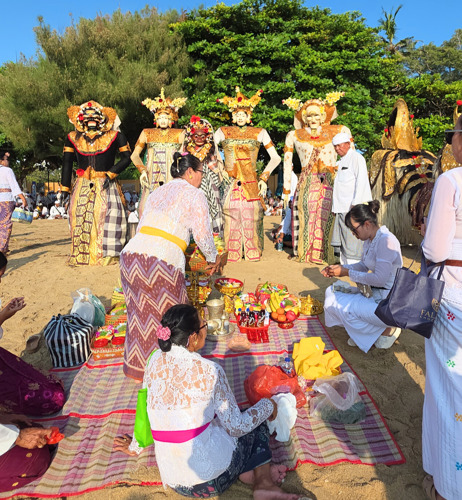
Nyepi - Melasti ceremony at the beach -
Nyepi follows the Saka lunar calendar and is connected to the new moon (Tilem). The dark moon symbolizes cleansing and new beginnings - perfectly aligned with the spiritual intention of silence and renewal.
Nyepi always marks the first day of the Saka New Year. Because it is based on the cycle of the moon, the date shifts each year, usually in March. -
These are the days to experience Nyepi:
2027 - March 8
2028 - March 26
2029 - March 15 -
Nyepi is unique in its full island-wide observance. While other cultures observe days of fasting or silence, nowhere else in the world does an entire international tourist destination shut down completely for spiritual reflection.
This is what makes Bali so special and why, for one day, the island becomes one of the quietest places on Earth.
-
Important practical information:
✈ Ngurah Rai International Airport closes for 24 hours
🚗 No transport operates
🏨 Hotels remain open with limited services
🌴 Guests must remain inside hotel premises
🚫 All shops & restaurants are closedWe always guide our guests carefully around Nyepi to ensure a smooth and respectful experience.
Why Nyepi matters to us
At Cili Travel, we focus on authentic cultural experiences and meaningful connections.
We cannot operate tours on Nyepi - and that is perfectly fine.
Because Nyepi reminds us why we love what we do.
We believe travel is not just about movement - it is about understanding.
Through our local guides, we help guests understand the deeper meaning behind ceremonies like Melasti, the symbolism of Ogoh-Ogoh, and the spiritual philosophy that shapes daily life in Bali. If you have any questions regarding Nyepi, you are always welcome to contact us.
Nyepi is not a closed day -
it is an open doorway into the soul of Bali
